
E-Commerce SEO Audit Checklist 2026

E-Commerce SEO Audit Checklist 2026 In an industry with fierce competition and many alternative shopping options online, it’s not enough to create just any type of ecommerce store. If you want to be found on search engines, tap into search engine organic traffic, and convert this traffic, your store must be optimized at the onset. The best way to do this is by conducting an e commerce SEO audit. A full SEO audit will show you all of the technical issues, on-page issues, and content issues, which may affect your chances of getting found on search engines (Google). This article will present you with a full E-commerce SEO audit checklist to assist you in evaluating your site and SEO objectively to achieve optimized performance. 1. Technical SEO Audit A strong foundation is essential. Technical SEO ensures search engines can properly crawl, index, and understand your ecommerce website. Read more: 10 Critical Technical SEO Errors and Solutions a. Crawlability and Indexing Use tools like Google Search Console, Screaming Frog, or Ahrefs to crawl your site. Check for blocked pages in `robots.txt` or with `noindex` tags. Ensure your most important pages (like product and category pages) are indexed. b. Site Speed Use Google PageSpeed Insights or GTmetrix to analyze speed. Compress images, enable browser caching, use a CDN (Content Delivery Network), and minimize JavaScript and CSS. c. Mobile Friendliness More than half of ecommerce traffic comes from mobile. Use Google’s Mobile-Friendly Test to ensure your design is responsive and fast on mobile devices. d. SSL Certificate Your site must use HTTPS. It’s a ranking signal and critical for user trust. e. Fix Broken Links & Redirects Identify 404 errors and fix or redirect them. Ensure 301 redirects are in place for moved pages or discontinued products. 2. On-Page SEO Audit Each product, category, and blog page must be optimized for relevant keywords and structured content. a. Meta Titles and Descriptions Make sure every page has a unique and descriptive title tag (under 60 characters). Write compelling meta descriptions (under 160 characters) that encourage clicks. b. H1 and Heading Tags Each page should have one H1 tag (usually the product or category name). Use H2s and H3s to structure content clearly. c. URL Structure Use short, keyword-rich, and descriptive URLs. Example: `yourstore.com/men-running-shoes` Avoid: `yourstore.com/product?id=123` d. Product Descriptions Avoid duplicate content (especially from manufacturers). Write original, informative, and keyword-optimized descriptions for each product. e. Alt Text for Images Every product image should have relevant alt text to boost SEO and accessibility. 3. Keyword Optimization Your site needs to rank for what your customers are searching for. a. Keyword Research Use tools like Google Keyword Planner, Ahrefs, or Ubersuggest. Target a mix of short-tail (e.g., “laptop”) and long-tail keywords (e.g., “best laptops under 50000 in India”). b. Category Pages Optimization Category pages often hold huge ranking potential. Add introductory text and optimize for broader keywords. Example: A category page for “Men’s Running Shoes” should include keyword-rich copy. c. Internal Linking Link between related products, categories, and blog posts. Helps distribute page authority and keeps users engaged longer. 4. Content Strategy Google loves fresh, valuable content. A content plan supports SEO growth and user trust. a. Blog Integration Write blogs around your niche, product guides, how-tos, and comparison posts. Example: “10 Must-Have Kitchen Gadgets in 2025” if you sell home appliances. b. Buyer Guides and FAQs Add buying guides and FAQs to product or category pages to target informational keywords. c. User-Generated Content Enable product reviews and ratings to boost content richness and social proof. 5. Site Structure & Navigation Good structure improves both SEO and user experience. a. Logical Site Hierarchy Keep your site 3 clicks deep max: Homepage > Category > Product Use breadcrumbs for easy navigation. b. Sitemap.xml & Robots.txt Submit your sitemap.xml in Google Search Console. Make sure robots.txt doesn’t block important sections of your site. 6. Schema Markup Structured data helps search engines better understand your site and improve how your listings appear. a. Product Schema Add markup for product name, price, availability, and reviews to appear in rich snippets. b. Breadcrumb Schema Improves click-through rate and shows a clean URL path in search results. c. FAQ & Review Schema Helps display answers or reviews directly on the SERP. Use tools like Google’s Rich Results Test or Schema.org to implement. 7. Backlink & Authority Audit Backlinks are a core part of SEO success. You should regularly assess your site’s link profile. a. Check Your Backlinks Use Ahrefs, SEMrush, or Moz to monitor referring domains and link quality. b. Disavow Spammy Links Identify and disavow toxic backlinks that could hurt your rankings. c. Build Authoritative Links Create link-worthy content, collaborate with bloggers/influencers, and get featured on niche directories. Read more: A Step-by-Step Guide to Mastering Link Building 8. User Experience (UX) & Engagement Signals Google now considers how users interact with your website. A good UX boosts dwell time and conversions. a. Improve Page Layout Highlight CTAs (Add to Cart, Buy Now) clearly. Avoid pop-ups that interrupt user experience. b. Optimize for Core Web Vitals Focus on LCP (Largest Contentful Paint), FID (First Input Delay), and CLS (Cumulative Layout Shift) for better rankings and smoother UX. c. Use Heatmaps & Analytics Tools like Hotjar or Clarity help you understand how users navigate and where they drop off. 9. Conversion Rate Optimization (CRO) SEO drives traffic. CRO turns it into sales. a. Check Checkout Process Minimize steps in the checkout process. Offer guest checkout and multiple payment methods. b. Use Trust Signals how security badges, return policies, customer reviews, and fast delivery icons. Final Thoughts SEO isn’t a one-off task; it’s a continual process. Following this Ecommerce SEO Audit Checklist will not only improve your rankings but will improve the overall experience for customers shopping at your site. You should start with a site-wide audit, fix the high-priority items identified, and create a plan to steadily adopt an Ecommerce SEO growth strategy.
Why Every Unique Travel Agency Needs a Best Travel CRM to Stay Competitive

Why Every Unique Travel Agency Needs a Best Travel CRM to Stay Competitive In this time of the digitalized era, the travel and tourism sector is not complete with hotel and flight bookings—it’s all about affordable and personal customer journeys, customer experience management (CEM or CXM), and fostering and nurturing relationships. This is where a unique travel CRM becomes groundbreaking. A CRM for travel industry is no longer a privilege. It’s indispensable. Whether you’re leading an affordable small travel agency, a corporate travel company, or a global travel agency, the main advantage of travel agency CRM is that it can enhance your customer service, automate operations, and increase your revenue. Let’s get back to how you can transform your travel business investment in the top travel CRM software, and it can revolutionize your travel business and keep you light years ahead of your competition. What is a travel CRM? A travel CRM (customer relationship management) system is a unified software tool designed for travel agencies, tour operators, and travel companies. Unlike traditional CRMs, which are built for general sales or marketing teams, CRM software for the travel industry focuses on unique travel workflows like The goal? Deliver a seamless, customized travel experience from the first inquiry to the return home. Why General CRMs Fall Short for Travel Companies You might think a generic CRM can do the job—but in reality, the travel industry has very specific needs that a traditional CRM cannot handle effectively. A CRM system for travel agencies understands: Only a dedicated travel CRM can adapt to these unique requirements, offering features that truly empower your travel business. Major Features of the Best Travel CRM Software When you’re researching the best CRM software, here are some features to list us : 1. Lead and Inquiry Management Capture leads from your website, email, phone calls, and social media into a single dashboard. Assign leads to your team automatically based on region, budget, or travel type. 2. Itinerary Builder Create custom itineraries in minutes using drag-and-drop tools. Add flights, hotels, transfers, and sightseeing in one visual flow. 3. Booking and Payment Tracking Monitor the entire booking process and payment schedule from inquiry to final confirmation. Integrate with payment gateways and send automated reminders. 4. Communication Automation Send one-by-one emails, SMS, chat support, and WhatsApp alert messages for reminders, trip updates, promotions, or customer feedback requests. 5. Document Management Store and manage passports, visa documents, tickets, and insurance paperwork securely within the system. 6. Reporting and Analytics Track team performance, sales conversion, revenue by destination, and customer satisfaction using real-time dashboards. 7. Third-Party Integrations The best travel CRM software supports integration with GDS (Amadeus, Sabre), accounting tools, email marketing platforms, and Google Workspace. Benefits of Using a CRM for Travel Companies Still unsure why you need a dedicated CRM for travel companies? Here are some unbeatable advantages: Enhanced Customer Experience Provide tailored recommendations and tailor-made offers, preferences, and behavior. Streamlined Operations Eliminate manual work, minimize errors, and enhance team productivity. Improved Sales Conversions Maintain the lead. You can track every inquiry from beginning to end and maximize your potential of closing. Real-Time Collaboration Boost up your sales and support, and make the operations teams work on the same platform without information silos. Scalable Growth Whether you’re a 5-person team or a 50-agent enterprise, a travel CRM scales with your growth. Travel CRM Use Case: From Inquiry to Booking in 5 Steps Let’s break down how a CRM for travel agency simplifies the entire customer journey. Step 1: Inquiry Captured A user fills out a holiday query form on your website. The CRM captures their details and sends an acknowledgment. Step 2: Lead Assignment Based on destination and budget, the lead is assigned to the right sales agent automatically. Step 3: Personalized Quotation The agent builds an itinerary using the CRM’s quotation tools and sends it to the customer with a click. Step 4: Booking Confirmation Customer approves the quote and uploads passport and visa documents. Payment links are shared via the CRM. Step 5: Post-Trip Follow-up After the trip, the CRM triggers an automatic feedback form and sends personalized thank-you messages. How Can I Choose the Best Travel CRM Not all of the CRMs are created equal. Whenever you’re analyzing travel agency CRM software, look out for the following major points given below: Top Signs You Need a Travel CRM Right Now If you’re experiencing any of the following, it’s time to invest in the Jaimru CRM, the best CRM in Delhi NCR: CRM for Travel Industry Trends in 2025 In 2025, CRM software for travel industry is expected to include: Staying ahead of these trends ensures you remain competitive and relevant. Final Thoughts It’s about aligning the CRM with business needs, strategic goals, and the unique requirements of the travel industry—it’s all about growing your business smarter or greater. A travel CRM authorizes you to deliver unexpected customer experiences, increase durability, and scale all types of operations—while ensuring team alignment. Whether you’re a newly opened startup company or a multi-city agency operator, investing in the best CRM for travel agency can be the turning point for long-term success. Ready to transform your travel business?Find out how Jaimru CRM, a powerful, convenient travel CRM software, can help you to manage leads, itineraries, bookings, and customers, all in one place. Start your free trial today and evolve your travel agency to new heights.
5 Essential CRM Features Every Travel Agency Website Needs
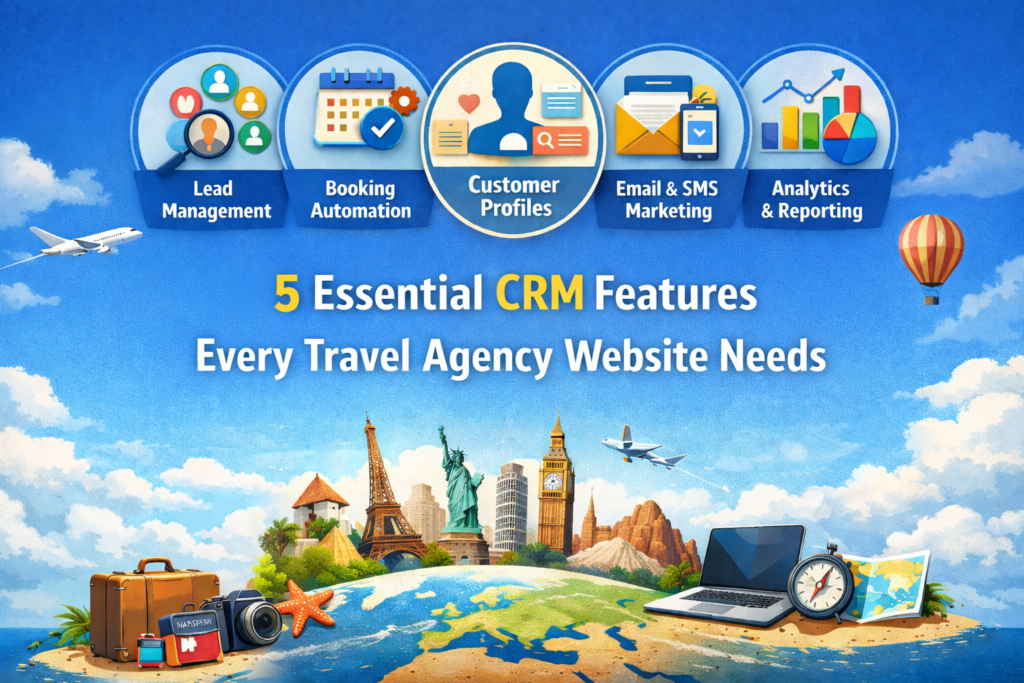
5 Essential CRM Features Every Travel Agency Website Needs In today’s travel scenario, make sure all types of customer satisfaction, maintaining a customer-first approach, and implementing business process optimization are crucial. With so many people planning their trips online, having a very powerful CRM system for travel agency is more important than ever. A CRM, or customer relationship management system, helps travel businesses handle customer info, follow up on leads, automate bookings, and offer a personalized experience. But not every CRM is the same. It’s energetic for a travel agency to choose us, Jaimru CRM, which fits all its specific needs. In this blog, we’ll go over five key features every travel agency should have in their CRM and how the right system can change how your agency connects with clients, increases sales, and builds loyalty. 1. Central Customer Database A clear customer database is the heart of any good CRM for travel agencies. This feature keeps all customer details—like contact info, trip history, preferences, and past conversations—organized in one spot. Why It’s Important: Better Personalization: Knowing your clients’ travel likes helps you recommend trips and offers they’d enjoy.Improved Communication: Having all past interactions in one place means no more repeating questions or missing details.Team Collaboration: Everyone involved in the process, whether it’s a travel advisor or support staff, can access the latest info. Tip: Select a CRM that links easily with your website so customer info goes straight into the system—cutting out manual entry mistakes. 2. Automated Lead Management Travelers often start planning with lots of questions and research. A strong CRM should help you manage potential leads right from the start. What to Look For: Lead generation: If someone provides information on this form, A new lead should be generated automatically Lead ranking: To provide a ranking, prioritize factors like budget and immediate need for assistance to focus on key contacts and identify the most important people to connect with us. Automated Follow-Ups: Set up email reminders to follow up with potential clients who haven’t booked. For example, send a guide or an offer the day after they inquire. Why It Matters: Quick and personal follow-ups can turn a casual browser into a customer. Automation keeps you organized, even when things get busy. 3. Integrated Booking and Itinerary Management A great CRM should work with booking tools and manage itineraries directly. This means your team can handle bookings from the CRM itself. Benefits: All-in-One Workflow: Rather than juggling different tools, agents can view preferences, send quotes, and manage bookings all in one place. Personalized Itineraries: Create custom itineraries with flights, hotels, and activities in a professional format for clients.Real-Time Updates: If plans change, you can easily update itineraries and notify customers through email or text. Industry Tip: Some CRM systems let clients tweak itineraries through a client portal for a smooth experience. 4. Multi-Channel Communication Tools Today’s travelers expect quick communication through various channels, like email, phone, chat, and social media. Your CRM should support all these to ensure no message is missed. What to Include: Email Marketing: Create email automations and newsletters. Blended Chat: Reach out to clients on different platforms like WhatsApp and Facebook Messenger directly from the CRM.Call Records: Keep logs of phone calls for easy reference and training. Why It Matters: Quick and reliable communication builds trust and helps your agency stand out. 5. Analytics and Reporting Dashboard To grow your business, you need to know what’s working and what’s not. Your CRM for travel industry should have a clear reporting dashboard. What to Track: Sales Pipeline: Visualize how leads become sales to see where you’re succeeding or losing business. Customer Groups: Segment customers by travel type or frequency for targeted marketing.Campaign Performance: Measure the success of your emails to improve future efforts.Agent Performance: Monitor how agents are doing to spot top performers and areas needing work. Tip: Use data to make smart choices about marketing, focus on certain destinations, and plan training. Bonus: Cloud-Based Access With many travel advisors working remotely, a cloud-based CRM is essential. This way, your data is available anywhere, and a mobile-friendly design helps agents respond to clients on the go. Choosing the best travel crm software With so many options out there, it’s important to find one designed for travel agencies—or at least easy to customize. Look for: Templates and workflows for travel.Integration with booking systems and payment options.A system that grows with you. Good customer support. Whether you’re a small agency or one dealing with a lot of clients and bookings, the right CRM can really make a difference. Get All the Personalized Travel Packages Using CRM Data Insights Personalizing travel packages using CRM (Customer Relationship Management) data insights involves leveraging customer data to tailor travel experiences that meet individual preferences, behaviors, and past interactions. Here’s a structured guide on how to do it: 1. Collect & Centralize Customer Data From CRM and beyond: 2. Segment Your Customers Use CRM data to group travelers into meaningful segments. Tools: Use segmentation features in CRM platforms like Salesforce, HubSpot, or Zoho. 3. Analyze Insights to Identify Trends Use data analytics tools or CRM dashboards to: 4. Create Personalized Travel Packages Tailor offers based on individual or segment data. Example: 5. Implement Real-Time Personalization Use AI-driven CRM systems to personalize in real time: 6. Track Results and Optimize Use CRM analytics to measure: A/B test different personalization strategies to improve effectiveness. 7. Ensure Privacy & Compliance Always comply with GDPR, CCPA, and other data privacy regulations. Final Thoughts Implementing a CRM for travel companies isn’t just about the tech—it’s about improving client relations and making processes smoother. Through the implementation of a unified data repository, automated leads, booking tools, communication options, and reporting, Ensuring your agency’s long-term sustainability Travelers today want personal touches, fast replies, and smooth service. The right CRM helps you provide this while giving your team the tools they need to succeed. If you’re ready to level up your travel agency, start by checking out CRM platforms made for travel. Investing in a solid CRM isn’t just smart—it’s crucial.
The 7 C’s of Marketing: A Modern Blueprint for Business Success

The 7 C’s of Marketing: A Modern Blueprint for Business Success In the hyper-competitive marketplace, conventional marketing models are often not able to satisfy the needs of consumers and brands. With the abundance of information available today via online and offline media outlets, Apps, etc, its understandable that marketers are becoming confused about how to approach a marketing strategy. Many marketers have adopted the 7 C’s of Marketing. The 7 C’s is a customer centric framework that and seeks to align business goals and objectives with the unpredictable nature of consumer behavior. Whether you’re an experienced marketer, an entrepreneur or a business owner/leader engaged in positioning their brand in the market, the 7C’s can give you the confidence to go out and execute your marketing activities. What Are the 7C’s of Marketing? The 7Cs of Marketing are: Customer, Content, Context, Community, Convenience, Cohesion, and Conversion. These 7 Cs of marketing are the framework to implement more engaging, more effective, more customer-centric marketing activities. Now, let’s unpack all of them in detail. 1. Customer – The Client The first and foremost “C” is Customer. Certainly, there can be no marketing strategy at all without really knowing the target audience. This encompasses demographics, psychographics, purchasing behavior, pain points, dreams, aspirations, and lifestyles. Why It Matters: Your entire marketing plan should be designed around the customer, not your product. Brands that listen to their customers and create solutions to their problems are far more successful than those that just push products. Key Questions to Ask: Who are my ideal customers?What problems are they trying to solve?What motivates their buying decisions? Tips: Use surveys, reviews, and social media insights.Create buyer personas to guide your campaigns.Monitor feedback and tweak your messaging accordingly. 2. Content – Your Value Messenger After you’re aware of your customers, the next step is to add value through Content. In the digital age, content is not only king, but is the whole kingdom. When it comes to content, it is everything from blogs and videos to social media posts and emails. Content helps us inform, educate, entertain, and convert. Why This is Important: Good content builds trust and establishes an authority for your brand. Good content also helps with SEO, social engagement, and lead generation. Key Questions to Consider: What type of content connects with my audience?Am I providing my audience with content that has true value or simply content noise?Am I using the best format for the platform? Tips: Diversify your content: blogs, infographics, reels, podcasts.Stay consistent with tone, message, and frequency.Always provide a solution or insight, not just promotion. 3. Context – Relevance Is Everything Even the best content could miss the mark if it does not have the appropriate Context. This refers to understanding when, where, and how your audience will consume information. Why It’s Important: Content, without context, is clutter. Context gives you the ability to personalize your message and provide material that actually triggers emotional and rational reaction. Key Questions to Consider: What stage of the customer buying journey are they in? – What is the best platform for this message? – What else is happening in my industry, and/or in the world, that affects my audience? Takeaways: – Segmentation of audience and create a tailored message for the relevant audience segment.– Use data and analytics to inform the timing and channel.– Stay aware of events and trends to keep content timely and relevant to consumers.– Use data and analytics to finalize the timing and channel.– Stay on top of trends to ensure content is relevant and timely for your audience.. 4. Community – Build Relationships, Not Just Reach In the age of social media, building a loyal Community is more important than chasing viral hits. Communities foster two-way communication and long-term loyalty. Why It Matters: Customers don’t just want to buy a product; they want to feel connected to a brand. Strong communities lead to repeat business, referrals, and user-generated content. Key Questions to Ask: How can I involve my customers in my brand story?Am I listening and responding to my community?Are there platforms where my audience gathers naturally? Tips: Engage with your followers via comments, DMs, and stories.Create forums, Facebook groups, or Discord channels.Highlight community members or user-generated content. 5. Convenience – Make It Easy to Buy Your product or service may be excellent, but if it’s not easy to find, understand, or buy, you’re losing sales. Convenience = Reducing friction at each step of the customer journey. Why Convenience Matters: Today’s consumer expects instant gratification. If a customer is having a difficult experience with your checkout process, or if your website is too slow, your competitor is just a click away. Key Questions to Ask: Is my website easy to navigate?Can customers find what they need quickly?Are there too many steps in the buying process?Tips: Optimize for mobile and ensure fast load times.Use clear CTAs (calls to action).Offer multiple payment and delivery options. 6. Cohesion – Unified Brand Experience Cohesion ensures that all your marketing efforts are aligned, consistent, and interconnected. It’s about having a clear brand voice, design style, and message across all channels. Why It Matters: Disjointed branding confuses customers. A cohesive strategy builds recognition and trust, making your brand feel reliable and professional. Key Questions to Ask: Is my branding consistent across all platforms?Do my ads, emails, and social media posts speak the same language?Are different departments aligned on brand messaging? Tips: Create a brand style guide and follow it religiously.Use the same tone, color palette, and logo placement.Ensure marketing, sales, and customer service are on the same page. 7. Conversion – Turning Interest into Action The final C is Conversion, the ultimate goal of any marketing strategy. Whether it’s getting someone to sign up, make a purchase, or book a call, conversion turns passive interest into meaningful action. Why It Matters: You can have great content and a large following, but without conversions, your efforts won’t translate into business success. Key Questions to Ask: What action do I want my
Unlocking Growth with a White Label Marketing Agency

Unlocking Growth with a White Label Marketing Agency In today’s ultra-competitive online world, businesses and agencies need to be able to scale fast, deliver excellent technical services and sustain a strong brand presence. Building an in-house team for every one of the services you want to offer to your clients — SEO, social media, PPC, content marketing — takes time, money, and a lot of hassle. A white label marketing agency like Jaimru Technology is your go-to answer. We are your invisible partner, providing excellent digital marketing services to your clients, allowing you to concentrate on acquiring new clients, fostering existing client relationships and scaling with confidence. What is a White Label Marketing Agency? A white label marketing agency provides digital marketing services that other businesses resell as their own. In other words, we do the work — you take the credit. With white labeling, your business can: Whether you’re a freelancer, startup agency, web developer, or IT company, white label partnerships can help you deliver more value to your clients while building your brand. Why Choose Jaimru Technology as Your White Label Partner? At Jaimru Technology, we understand what agencies and resellers need: reliability, transparency, quality work, and complete confidentiality. Here’s why agencies across India (and beyond) trust us as their go-to white label marketing agency: 1. Comprehensive Service Suite We offer full-stack digital marketing services, including: 2. White Label Confidentiality We operate completely behind the scenes. Whether we’re communicating with your clients or preparing reports, we act 100% under your brand. Your clients never know we exist — and we like it that way. We sign NDAs (Non-Disclosure Agreements) with all our partners to ensure full confidentiality and peace of mind. 3. Dedicated Project Managers You’ll be assigned a dedicated project manager who understands your brand voice, workflow, and timelines. This ensures consistency, clarity, and efficiency in every project we handle for you. 4. Scalable & Flexible Engagements Whether you have 1 client or 100, we scale with you. Need just a few SEO backlinks this month? Done. Need 20 landing pages, 10 social media calendars, and 5 ad campaigns next month? We’ve got you. Jaimru Technology adapts to your volume and pace, so you can say “yes” to every opportunity without worrying about delivery capacity. 5. Transparent Reporting We provide detailed, white-labeled reports with: You can present them directly to your clients, saving hours of work every month. 6. Affordable & High-Quality Services Outsourcing doesn’t have to mean sacrificing quality. At Jaimru Technology, we balance cost-efficiency with premium service delivery. This means higher profit margins for you — without compromising results. Who Should Partner with a White Label Marketing Agency? White label partnerships are ideal for: Even established marketing agencies use white label partners to handle overflow work or provide services outside their core expertise. Real-World Example: How We Helped an Agency Scale 3x One of our agency partners in Delhi approached us with just 5 clients. They handled design and web dev, but wanted to offer SEO and paid ads. Within 6 months of partnering with Jaimru Technology: They focused on sales. We took care of delivery. Our Process: Simple & Seamless 1. Discovery Call We learn about your brand, services, and client expectations. 2. Service Selection Choose from our digital marketing offerings based on what you want to resell. 3. Execution & Delivery We handle the work, you get daily/weekly updates and white-labeled reports. 4. Client Communication You choose: We can either work directly with you or communicate (under your brand) with your client if required. 5. Ongoing Optimization We continuously optimize performance to ensure long-term client satisfaction. Ready to Scale? Let’s Grow Together. If you want to offer more services, close more deals, and focus on what you do best, a white label partnership with Jaimru Technology is the next step. We’re more than an agency — we’re your invisible team, your silent engine for growth, and your secret weapon in digital marketing. Contact Us Today Let’s build something great — under your name, powered by Jaimru Technology.
Top 10 Mobile App Development Trends in 2026

Mobile App Development Trends in 2026 The mobile app industry is changing quickly. In 2025, mobile app development trends will not just amend how mobile applications function, they will also modify how we envision user habits and what a business can become within those applications. As there are now over 7 billion mobile users of the device across the globe, we have a paramount responsibility as developers, entrepreneurs, and businesses to embrace the latest trends. Here are the top 10 mobile app development trends you need to watch in 2025. 1. AI-Powered Applications AI is leading the way for mobile app development. AI is transforming the way apps are created with chatbots, predictive analytics, biometric and voice recognition, text and speech translation, and personalization that improves performance and enriches user experience. In 2025, on-device AI will increasingly help with image recognition, smart replies, automatic text translation, and voice recognition. AI will remain a core function of healthcare, fintech, and eCommerce applications as they automating their functionality to improve customer experience. Why it matters: AI enables mobile apps to think and act intelligently, reducing human intervention while boosting performance and engagement. 2. 5G-Enabled App Experiences The worldwide deployment of 5G is changing the mobile landscape. It delivers ultra-low latency, faster data speeds, and great connectivity, and it gives developers opportunities to build high-performance mobile apps. By 2025, app developers will use 5G to support smooth streaming, multiple simultaneous users, AR/VR experiences, and real-time data-processing scenarios. Why it matters: 5G significantly improves app speed, responsiveness, and functionality—especially in real-time services. 3. Cross-Platform App Development There was a time when you had to create separate code for applications for Android and iOS. However, now there is a growing number of cross-platform frameworks like Flutter, React Native, and Kotlin Multiplatform. This also means more companies using this type of technology to develop faster, have reduced costs and have more consistency across the board. Why it matters: Cross-platform development accelerates time-to-market and simplifies app maintenance. 4. Progressive Web Apps (PWAs) By employing Progressive Web Apps (PWAs), companies are beginning to realize a viable alternative to native mobile applications. PWAs bring all of the efficiency of mobile applications with some of the flexibility of web pages – opening quickly, available offline, not needing to go through the time-consuming installation process from the app store. Companies such as Twitter, Starbucks, and Pinterest have begun growing their engagement in increased numbers after the adoption of PWAs. Why it matters: PWAs offer cost-effective, accessible solutions, especially in regions with limited connectivity or storage capacity. 5. AR and VR Integration Augmented Reality (AR) and Virtual Reality (VR) are established beyond gaming. In 2025, we will see a broader application of AR for Retail, Education, Real Estate, and Healthcare apps. For example, AR will allow a customer to try on an article of clothing virtually or visualize furniture in a customer’s home prior to purchase. VR is advancing into virtual tours, remote training, and immersive learning experiences. Why it matters: AR/VR enriches user interaction and opens new possibilities for experiential marketing and engagement. 6. Internet of Things (IoT) Integration Created, designed and developed by developers, who are reliant on trusted partners to fulfill the commitment to deliver expected, timely and on-budget results. Mobile apps that connect smart devices to mobile apps. Home automation and fitness devices to industrial devices and connected vehicles, apps for IoT are becoming integral. In 2025, mobile applications will primarily serve as controls and dashboards for data, from smart devices. Why it matters: IoT enhances convenience, automation, and data-driven decision-making for both consumers and enterprises. 7. Enhanced App Security and Privacy Data breaches and cyber threats are growing rapidly. Business and mobile app security are going to be vital paths of growth for organizations going forward. With very strict regulations such as GDPR and evolving expectations from users and customers of applications, developers creating apps, both enterprises and otherwise should start to implement effective security protocols. By 2025, more applications will be built with biometric authentication, data encryption, and AI-powered threat detection built into them. Why it matters: Security builds user trust and ensures compliance with global data protection laws. 8. Voice Search and Conversational Interfaces Voice technology is developing rapidly and building upon the established groundwork from traditional voice-enabled virtual assistants such as Siri, Google Assistant, and Alexa, which are integrated into apps. By 2025, we expect voice technology to become even more integral to mobile applications in search, browser navigation and control, and accessibility and usability. Conversational tools or interfaces that facilitate conversation with customers and improved customer support, notably AI (artificial intelligence) chatbots, will make businesses easier to transact with, and make mobile applications easier for users to use. Why it matters: Voice and chat interfaces offer hands-free, intuitive experiences that improve accessibility and usability. 9. Low-Code and No-Code Development At present, low-code and no-code platforms enable organizations and non-developers to build functional apps without extensive programming knowledge. Platforms including Microsoft Power Apps, OutSystems, and Adalo are making the process of app development easier. By 2025, we will likely see enterprises, governments and NGOs use these platforms to prototype, test, and deploy applications much faster. Why it matters: These platforms reduce development time and democratize innovation within organizations. 10. Blockchain Integration The technology of Blockchain is branching out beyond the cryptocurrency world. There are increasingly more mobile applications that utilize decentralized technology to support secure transactions, trust identity, manage assets, track supply chains, etc. Blockchain apps will impact peer-to-peer payment transactions, secure digital contracts, and verification of data by 2025. Why it matters: Blockchain increases transparency, reduces fraud, and secures sensitive data in mobile environments. Final Thoughts Developers and businesses cannot ignore these trends as the mobile app ecosystem becomes even more complex and competitive. The mobile app development trends of 2025 focus on intelligence, immersion, speed, and security—these trends represent the future and ultimately enhance user satisfaction and spur innovation. Keeping up with trends means investing in the right technologies, frameworks, and development strategies. Startup
How to Choose the Right Mobile App Development Framework

Choose the Right Mobile App Development Framework The correct choice can also affect how scalable the app can ultimately be, how cost-effective you can develop an app, how quickly you can take an app to market, and ultimately the success of your mobile app. This guide will give an overview of important considerations, mobile app development trends, and characteristics of mobile app development frameworks, to help you make a confident decision, on what framework is most suitable for your business needs. What is a Mobile App Development Framework? A mobile app development framework is essentially a software framework that includes tools, libraries, and principles to facilitate the development process. Developers will take advantage of mobile app development frameworks by providing one code and deploy to different platforms. Each time a developer makes an update, they only update one code. Developers will use the specific mobile app development framework and they will be able to build apps for both iOS, Android, or the web. There are three primary types of frameworks: 1. Native Frameworks (e.g., Swift for iOS, Kotlin for Android)2. Cross-Platform Frameworks (e.g., React Native, Flutter)3. Hybrid Frameworks (e.g., Ionic, Cordova) Each type has its unique strengths and weaknesses, depending on the app’s complexity, performance requirements, and target audience. Why Framework Choice Matters in 2026 The rate of mobile innovation across 5G, AR/VR, AI, edge computing, will affect user demands and ubiquitous computing and your framework must consider these changes without major burdens to the device. In this challenging environment, there are issues of cost, available developers, and speed to market that make cross-platform and hybrid mobile development much more reasonable in some situations. Key Factors to Consider When Choosing a Framework 1. App Requirements and Use Case A native build is not required for every program. Think about what your app is trying to do: 2. Platform Support Determine whether you’re targeting Android, iOS, or both. If both, cross-platform development can save time and cost by sharing up to 90% of the codebase. React Native and Flutter are dominant players here, offering near-native performance with shared code. 3. Performance Expectations Apps that require high-speed graphics rendering, sensor access, or real-time functionality (like video calls or games) benefit from native development. Cross-platform frameworks have come a long way but may introduce performance lags under extreme processing. 4. Developer Expertise and Community Support Evaluate your in-house team’s skills. If your developers are familiar with JavaScript, React Native might be the logical choice. For Dart, Flutter fits well. Also, consider the community and ecosystem size—larger communities offer better support, documentation, and third-party plugins. 5. Development Time and Budget Cross-platform and hybrid frameworks typically reduce time-to-market and cost, especially for MVPs and startups. Native development, while more expensive and time-consuming, pays off in UX and app responsiveness when needed. 6. Third-Party Integration and Plugin Availability Some applications require integration with device hardware (GPS, Camera, NFC). Make sure the framework you choose supports or has plugins for these features. Flutter and React Native both offer extensive plugin ecosystems. 7. Scalability and Maintenance Choose a framework that will grow with your app. It should support frequent updates, modular codebases, and efficient testing. Frameworks backed by tech giants (e.g., Google for Flutter, Meta for React Native) are more likely to remain updated and stable. 8. Security and Compliance Security concerns are rising in mobile app development. Your framework should enable secure coding, data encryption, and standards compliance globally, such as GDPR and HIPAA. Native apps are often better at allowing developers to leverage full device-level security, but cross-platform frameworks are evolving quickly. Top Mobile App Development Frameworks in 2026 1. Flutter 2. React Native 3. Swift (iOS) and Kotlin (Android) 4. Xamarin 5. Ionic Matching Frameworks with Business Goals Business Goal Best Framework MVP Launch Flutter or React Native High-performance UI Flutter or Native Fastest Time to Market React Native or Ionic Complex Enterprise Apps Xamarin or Native AR/VR Integration Native (Swift/Kotlin) Cost Optimization Flutter, React Native Future-Proofing Your Framework Choice With mobile app development trends pointing toward voice interaction, AI-enhanced experiences, and wearable integrations, ensure your chosen framework is actively maintained and forward-compatible. Avoid niche or declining frameworks with limited community support. For example, Flutter’s upcoming support for embedded devices and React Native’s integration with Fabric and TurboModules show they’re evolving to meet future needs. Final Thoughts Choosing the right framework is a strategic one when it comes to developing a mobile app. It not only defines the technical implementation, it also affects sustainability, cost, and end-user satisfaction long after the app is built. By evaluating the functionality of a framework according to your apps functional needs and your business goals for the app, in addition to current trends in the mobile app development sector, you improve the chances of a successful project. Carefully weigh the options out there, keep an open and inquisitive mind towards changing technology, and pick a framework that will allow your development team to deliver at speed , but also maintain flexibility! Check out Jaimru Technology Private Limited as a mobile app development Company in Delhi.
The Ultimate Guide to Mobile App Development for Beginners

The Ultimate Guide to Mobile App Development for Beginners Of all skills in today’s digital ecosystem, mobile app development is incredibly common and popular. With mobile devices ubiquitous, mobile app development is the major way that businesses interact with customers and is one of the most effective ways developers can demonstrate their skills. If you’re just starting to understand mobile app development, this guide will explain how to go from nothing to your first app. In 2025, mobile app development is still changing and recognizing trends can change everything. This guide is for you whether you’re building an app for the fun of it, for your business, or simply looking to work in mobile development. Understanding Mobile App Development Mobile app development refers to the process of creating software applications that run on mobile devices like smartphones and tablets. There are three main types of mobile apps: Choosing a Platform Before diving into the development process, you need to decide which platform(s) you want your app to run on. The two most popular mobile platforms are: You also have the option of building cross-platform apps, which run on both iOS and Android. Frameworks like Flutter (by Google) and React Native (by Meta) allow developers to write a single codebase for both platforms. Key Tools and Technologies for Mobile App Development 1. Programming Languages 2. Integrated Development Environments (IDEs) 3. Mobile App Development Frameworks The Mobile App Development Process 1. Idea and Planning Every app begins with an idea. Before you code it is important to define exactly what your app will do and who it will serve. Focus on the message below: Developing user personas and mapping the key features of your app will help you establish a starting point for when you move to the next phase of development.. 2. Designing the App After you have described the concept of your app, you will start designing the user interface (UI) and user experience (UX). This is a step where you will create wireframes to develop a visual representation that depicts the framework of each screen on the app. You may design your app using Figma, Sketch, and/or Adobe XD. All of these are designed to help you visualize the flow of the app to make sure the final product will be usable and functional. 3. Development Next, we move into the coding part of the project. Depending on the tool you chose (iOS, Android, or cross-platform), you will begin to technically develop the app using the correct languages and platforms. 4. Testing Testing is a crucial phase in mobile app development. This ensures that your app works smoothly on a variety of devices and OS versions. There are several types of testing, including: Testing can be done manually or using automated testing tools like Appium and TestComplete. 5. Deployment Once your app has been thoroughly tested and is free of bugs, it’s time to deploy. For iOS apps, you will submit your app to the App Store via App Store Connect, where it undergoes a review process before being published. For Android apps, you will submit your app to the Google Play Store. 6. Maintenance and Updates Post-launch, it’s crucial to monitor the app’s performance and user feedback. Address any issues, bugs, or security concerns promptly. Regular updates will keep your app relevant and functional. Mobile App Development Best Practices Conclusion Mobile app development can seem daunting at first, but by following this guide, you can build a strong foundation for your app development journey. From planning and designing to coding and testing, the process is manageable with the right tools and resources. Whether you’re aiming to build your first app as a beginner or looking to refine your skills, the demand for mobile apps is only growing, and staying ahead of mobile app development trends will set you up for success in 2025 and beyond.
AI in Travel CRM: How Artificial Intelligence Is Transforming Customer Experience

AI in Travel CRM: How Artificial Intelligence Is Transforming Customer Experience The travel industry has always been innovative in creating exceptional customer experiences. Even if it’s booking new flights, managing all itineraries, or finding them the best hotel in the world, today’s travelers are expecting lots of customized, seamless, and very responsive service areas. Enter artificial intelligence (AI)—a most life-changing technology that is rapidly revisiting how all the travel companies can interact with their customers. One of the most crucial areas AI is transforming is customer relationship management (CRM). By placing intelligence into various CRM platforms, all the travel businesses are unlocking new potentiality that wasn’t possible recently, in the last few years. From advanced analytics to on-the-spot personalization, AI is fostering stronger customer relationships and satisfaction. In this post, we’ll explore how AI is changing customer experience in the travel sector through CRM, the benefits it brings, real-world applications, and what travel companies can do to stay ahead of the curve. The Role of CRM in Travel Prior to exploring AI’s function, it’s very important to understand what a CRM system can do for a travel agency. A travel CRM is a universal software that helps travel agencies, tour operators, airlines, and hospitality providers manage all their customer interactions across various methods like email, web, social media, and more. Its fundamental aspects are Traditionally, CRM systems were more instinctive than forward-thinking. They stored all the data, helped with customer segmentation, and executed campaigns but lacked the intelligence to make real-time decisions or adapt dynamically to customer behavior. That’s where AI comes in. What AI Brings to the Travel CRM Table Artificial Intelligence enhances traditional CRM capabilities by introducing: AI uses retrospective data to predict customer behavior. For point out, it can forecast when a repeat traveler is expected to plan their next trip and provides applicable deals. With NLP, AI can acknowledge and analyze human languages. This enables chatbots and virtual assistants to handle customer queries with increasing accuracy, reducing response time and improving user experience. AI can analyze data from a user’s current session (location, device, clicks) to tailor recommendations and offers instantly. No more static “one-size-fits-all” marketing. AI can evaluate customer emails, reviews, or social media posts to determine sentiment—positive, neutral, or negative—and prompt customer service teams to act accordingly. AI automates routine tasks like itinerary creation, reaching out to emails, booking confirmations, and many more. This strong match of human agents to concentrate on more complicated, one-on-one interactions. Real-World Examples of AI in Travel CRM Let’s take a look at how leading travel businesses are leveraging AI within their CRM ecosystems. Expedia uses AI to allow customized hotel and flight recommendations based on user behavior, search history, and engagement trends. Its CRM combines this intelligence to make sure that each customer receives all the relevant offers, enlarging the likelihood of conversion. Hilton’s AI-powered janitor, Connie, helps guests with local directions, amenities information, and dining recommendations. Integrated with CRM, Connie also captures feedback and behavior data for future personalization. Using smart segmentation, Lufthansa’s CRM dynamically adjusts email content based on a traveler’s recent destinations, loyalty tier, and preferences. This has enhanced engagement and click-through rates. How AI Enhances Each Stage of the Customer Journey AI’s power in CRM is felt across the entire customer lifecycle, from acquisition to retention: AI tracks user interactions and preferences during the research phase. It can offer destination suggestions, send targeted ads, and recommend tailored itineraries, all within the CRM system. AI enhances the booking experience through virtual assistants and voice assistants. It can deliver quick pricing, manage direct changes, and offer complementary services like travel protection plans , insurance plans, or business class seating CRM systems powered by AI can send timely reminders, provide visa or COVID-related travel alerts, and suggest upgrades based on the user’s travel history. AI enhances in-trip experiences by offering real-time support. CRM tools can alert customers of delays, recommend nearby attractions, or even offer dining options based on current location and past reviews. After a trip, AI tools in CRM platforms can request feedback, analyze sentiment, and determine the best time and channel for re-engagement—helping to nurture long-term loyalty. Benefits of AI-Integrated Travel CRM The integration of AI in travel CRM software? systems brings a suite of tangible benefits for travel companies: AI speeds up more reliable responses, more customized personalization, and 24/7 service—leading to satisfied customers. With better targeting, upselling, and personalized offers, companies see higher conversion rates and customer lifetime value. Via task automation and decision-making, AI decreases workload for all the staff and reduces errors. AI continuously learns from customer behavior and feedback, offering travel companies an evolving picture of what their customers want. Challenges and Considerations While AI in travel CRM offers unbelievable opportunities, it’s not without any risks and problems: Customers are becoming more careful about how all their data is used. AI systems must follow the law, like GDPR, and make sure that data handling. Include AI into legacy CRM systems can be difficult to find and use accurately, requiring considerable financial resources in both durations and all the available funds. Automated systems can’t fully replace human touch, especially in high-emotion or high-stakes travel scenarios (e.g., cancellations or emergencies). AI is only as good as the data it learns from. If the data is biased, the recommendations or responses could be, too—affecting customer trust. How Travel Businesses Can Get Started For companies looking to enhance their online travel software for travel industry? with AI, here are some practical steps: The Future of AI in Travel CRM As AI continues to evolve, the next frontier in the best travel CRM may include: The possibilities are vast—and we’re just scratching the surface. Final Thoughts AI is a game-changer; it’s a strategic necessity for travel companies seeking to offer memorable and efficient customer experiences. Integrated with travel agency CRM software platforms, AI empowers businesses to engage smarter, serve faster, and build deeper customer relationships. Travelers no longer compare your company to other agencies—they compare you to the best
How to Rank Your App in Google Play Store Using ASO

Google Play Store Using ASO With the app usage and downloads on the rise, the app ecosystem is becoming more competitive than ever. Chances are, your app may get buried in millions of other apps on the Google Play store. And with so many other app options, even developing the most useful app won’t get you anywhere if your app does not gain exposure to potential users. That is when App Store Optimization, or ASO, becomes useful. ASO is the practice of correctly positioning various elements of your app listing in order to increase visibility and rankings in app store search results. In this guide, we will describe how to carry out ASO principles correctly in order to increase your app’s ranking and drive more organic downloads through the Google Play Store. What Is ASO & Why Is It Important? In mobile, App Store Optimization (ASO) is similar to Search Engine Optimization (SEO) in the web world. App Store Optimization takes elements of optimization and focuses them on ranking your app higher in the Play Store search results and top charts in order to drive more downloads. Key benefits of ASO: Google’s Play Store algorithm takes into account several factors including keyword relevance, app performance, download velocity, and user engagement when ranking apps. 1. Choose the Right Keywords The Mistake: Using irrelevant or low-volume keywords can result in poor discoverability. Best Practice: Read more: SEO Keywords: What They Are, Best Practices, and How to Rank in 2025 2. Optimize App Title and Subtitle The Mistake: A generic app name that lacks keywords reduces search visibility. Best Practice: Include your most important keyword in the app title. For example: `Sleep Tracker: Smart Alarm & Sleep Sounds` 3. Craft a Compelling Short Description The Mistake: Wasting the 80-character short description with vague statements. Best Practice: Example: “Track sleep patterns, set smart alarms, and improve your sleep quality naturally.” 4. Optimize the Long Description with Relevant Keywords The Mistake: Writing a long description filled with marketing jargon and no keyword strategy. Best Practice: 5. Use High-Quality App Icons and Screenshots The Mistake: Neglecting the visual elements of your app store listing. Best Practice: 6. Encourage Positive Ratings and Reviews The Mistake: Failing to engage with users post-download or ignoring negative feedback. Best Practice: Tip: Apps with consistent positive reviews rank higher and gain user trust faster. 7. Regularly Update Your App The Mistake: Letting your app stagnate with outdated features or unresolved bugs. Best Practice: 8. Focus on App Performance and Technical Quality The Mistake: Ignoring crash rates, slow load times, or bugs. Best Practice: Google uses app performance metrics like ANRs (Application Not Responding) and crash rates as ranking signals. 9. Increase Retention and Engagement The Mistake: Focusing only on downloads without measuring retention. Best Practice: Apps with high retention rates tend to rank higher because Google interprets this as a sign of user satisfaction. 10. Localize Your App for Different Markets The Mistake: Targeting only English-speaking users. Best Practice: Bonus Tip: Track and Measure Your ASO Performance Use analytics tools to track keyword rankings, conversion rates, and user feedback. Tools like Sensor Tower, AppFollow, and Google Play Console provide valuable insights to refine your strategy. Conclusion Ranking your app in the Play Store is an ongoing process; optimization can define discoverability, organic downloads and ultimately user retention – however you need to follow best practice methodology in to do ASO. You should constantly work on every aspect of the listing; keywords, images, user ratings, performance, etc. Remember that ASO is not solely about discovery, it is also about convincing that user to download and then continue using your app.